EBEORL-HNS Part I Mock Papers

Timed past‑paper practice that makes pace feel automatic

Use these Part I papers to practise closed‑book decision‑making under time pressure — then review thoroughly and turn misses into repeat wins. This is how you train execution (pacing, stamina, discipline), not just knowledge.

  • Exam‑condition rehearsal (timed, closed‑book mindset)
  • Explanations that teach — convert errors into short “rules”
  • Bundle option (A–E) for a clean run‑in plan
  • Pairs perfectly with the question bank (learn → test → rehearse)

Independent educational resource; not affiliated with UEMS / EBEORL‑HNS.

Pace + staminaTrain timing under pressure
Repeatable workflowRules list + re‑sit misses
Structured run‑inBundle (A–E) available
Illustration of an exam pacing timer and checklist cards for timed mock paper practice

What these mock papers train

The behaviours that move scores: time discipline, recognition, and clean decisions.

Exam conditions mindset

Treat each sit like exam day.

  • Timed (no pausing)
  • Closed‑book (no looking up)
  • Single‑best‑answer decisions

Knowledge → execution

Use the question bank to learn; use mocks to rehearse.

  • Rule creation from explanations
  • Weak‑area targeting between sits
  • Endurance rehearsal in the final weeks

Pick your paper

i
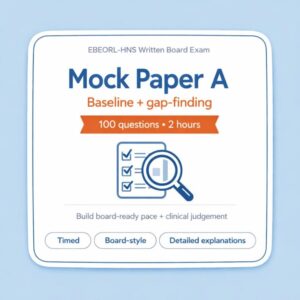
Simple schedule: Paper A 8–10 weeks out (baseline). Then one sit weekly. In the final month, rehearse with two papers back‑to‑back + a short break. Finish with Paper E or the Bundle (A–E).

Recommended: Full Bundle (A–E)

⭐ Best value

Pair mocks with the question bank for faster improvement

The fastest loop is: learn in the question bank (explanations + targeting) → measure in mocks (timed execution). After each sit, do 2–3 short targeted sessions on your weakest areas before the next paper.

Illustration showing question bank practice flowing into performance analytics and progress trends

How to use these papers (high‑yield workflow)

i
A simple loop that builds pace, accuracy, and calm decision‑making.
  1. Baseline early: sit Paper A 8–10 weeks out as your reality check.
  2. Simulate properly: timed, closed‑book, no pausing, no looking things up.
  3. Tag every miss: knowledge gap vs misread vs overthinking vs timing.
  4. Build a “Rules List”: 20–40 one‑liners; review every 48–72 hours.
  5. Re‑sit misses: 48–72 hours later, re‑attempt missed questions only.
  6. Final month: do two papers back‑to‑back + short break to rehearse endurance.

If time is tight: do one full sit + one targeted weak‑area block weekly. Consistency beats marathon sessions.

Illustration of a study roadmap with milestones leading to a trophy for exam readiness

FAQs

Quick answers before you buy a mock paper or the bundle.

Are these official EBEORL‑HNS questions or past papers?

No — these are board‑style mock papers designed for exam‑condition rehearsal. OtoPrep is independent and not affiliated with or endorsed by UEMS / EBEORL‑HNS.

Should I buy the Bundle (A–E) or individual papers?

If you want the cleanest run‑in plan, the Bundle (A–E) is simplest. If you’re late in prep, start with one timed sit, build a “rules list,” then iterate quickly with another paper.

How far out should I start mock papers?

Ideally 8–10 weeks out with Paper A as a baseline, then one sit weekly. In the final month, add an endurance rehearsal (two papers back‑to‑back with a short break).

Do I still need the question bank if I’m doing mocks?

Yes — the fastest loop is question bank for learning + targeting, and mock papers for timed execution. After each sit, do 2–3 short weak‑area blocks in the question bank.

Is there a free trial for the EBEORL‑HNS question bank?

Yes — start the free trial to explore the platform and experience the SBA style before choosing a plan.

Start the EBEORL‑HNS free trial

Ready to rehearse EBEORL‑HNS Part I?

Start early with Paper A, then build toward full exam‑condition simulations — or grab the Bundle (A–E).

Disclaimer: OtoPrep is an independent educational resource and is not affiliated with UEMS / EBEORL‑HNS.